
All attractions
Overview
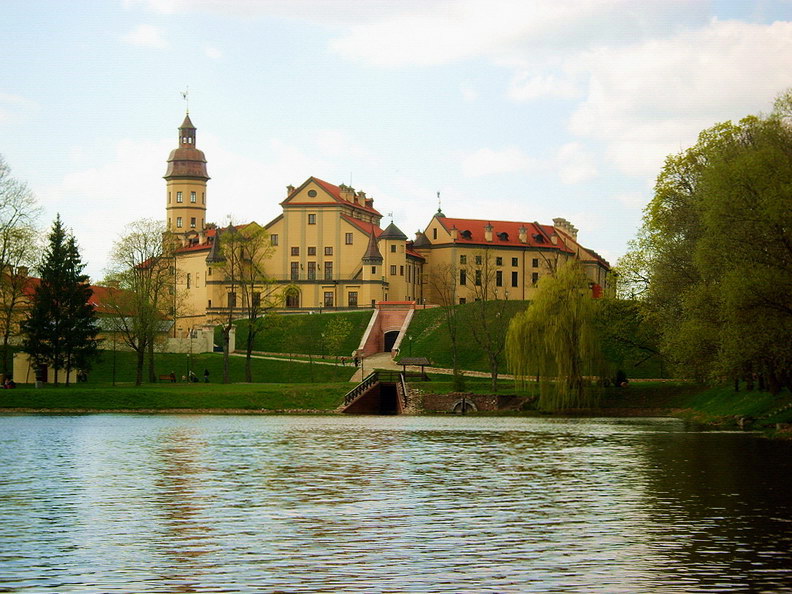
A UNESCO World Heritage Site, Nesvizh Palace is one of the most significant architectural and cultural monuments in Belarus. This vast palatial complex seamlessly blends Renaissance, Baroque, and Classicist styles across centuries of continuous development by the powerful Radziwill dynasty.
History
Founded in the late 16th century as a bastion fortress, Nesvizh evolved over centuries into a grand aristocratic residence. The Radziwills — one of the most powerful families in the Grand Duchy of Lithuania — established here a theater, an orchestra, a printing press, and one of the finest libraries in Europe.
The palace endured devastating blows: Russian forces damaged it in 1655, Swedish troops captured and looted it in 1706, and Napoleon's wars in 1812 brought the most lasting consequences. Prince Dominik Radziwill sided with Napoleon, and after the French defeat, Russian forces seized the castle's treasures: over 12,000 coins and medals were sent to Kharkiv, valuables weighing nearly one ton disappeared to Moscow and Petersburg. The famous "Twelve Apostles" — a set of precious objects — vanished after 1812 and were never recovered. The Radziwills were forced into exile in Berlin and Poznań for decades, and the castle deteriorated. When the family finally returned in 1865, they found collapsed ceilings, destroyed roofs, excavated courtyards, and "incredible filth."
From 1944 to 1998, the palace served as a Soviet sanatorium — first under the NKVD, then as an inter-kolkhoz health resort treating nervous system and heart conditions, with 175 beds serving ~3,000 patients per year. The parlors became medical wards, steam heating replaced original fireplaces, and irreplaceable 16th–17th century Dutch tile panels were destroyed. Yet some elements survived — Radziwill fireplaces in the dining hall and a billiard table that patients used regularly.
Restoration began in 1998 when the sanatorium closed. Nesvizh was inscribed as a UNESCO World Heritage Site in 2005 and fully reopened to tourists in 2012.
The palace endured devastating blows: Russian forces damaged it in 1655, Swedish troops captured and looted it in 1706, and Napoleon's wars in 1812 brought the most lasting consequences. Prince Dominik Radziwill sided with Napoleon, and after the French defeat, Russian forces seized the castle's treasures: over 12,000 coins and medals were sent to Kharkiv, valuables weighing nearly one ton disappeared to Moscow and Petersburg. The famous "Twelve Apostles" — a set of precious objects — vanished after 1812 and were never recovered. The Radziwills were forced into exile in Berlin and Poznań for decades, and the castle deteriorated. When the family finally returned in 1865, they found collapsed ceilings, destroyed roofs, excavated courtyards, and "incredible filth."
From 1944 to 1998, the palace served as a Soviet sanatorium — first under the NKVD, then as an inter-kolkhoz health resort treating nervous system and heart conditions, with 175 beds serving ~3,000 patients per year. The parlors became medical wards, steam heating replaced original fireplaces, and irreplaceable 16th–17th century Dutch tile panels were destroyed. Yet some elements survived — Radziwill fireplaces in the dining hall and a billiard table that patients used regularly.
Restoration began in 1998 when the sanatorium closed. Nesvizh was inscribed as a UNESCO World Heritage Site in 2005 and fully reopened to tourists in 2012.
What to see
The palace interiors with period rooms and exhibitions. The Corpus Christi Church (1593) — the first Baroque church in the region. The extensive landscape park system with walking trails, ponds, and pavilions. In winter: the snow-covered parks create a completely different atmosphere — familiar summer paths become magical frost-lined corridors, and the palace looks especially dramatic against grey winter skies.
Share your photos or videos of this place
Sign in to upload photos and videos.
Adapted from: Onliner.by