
All attractions
Overview
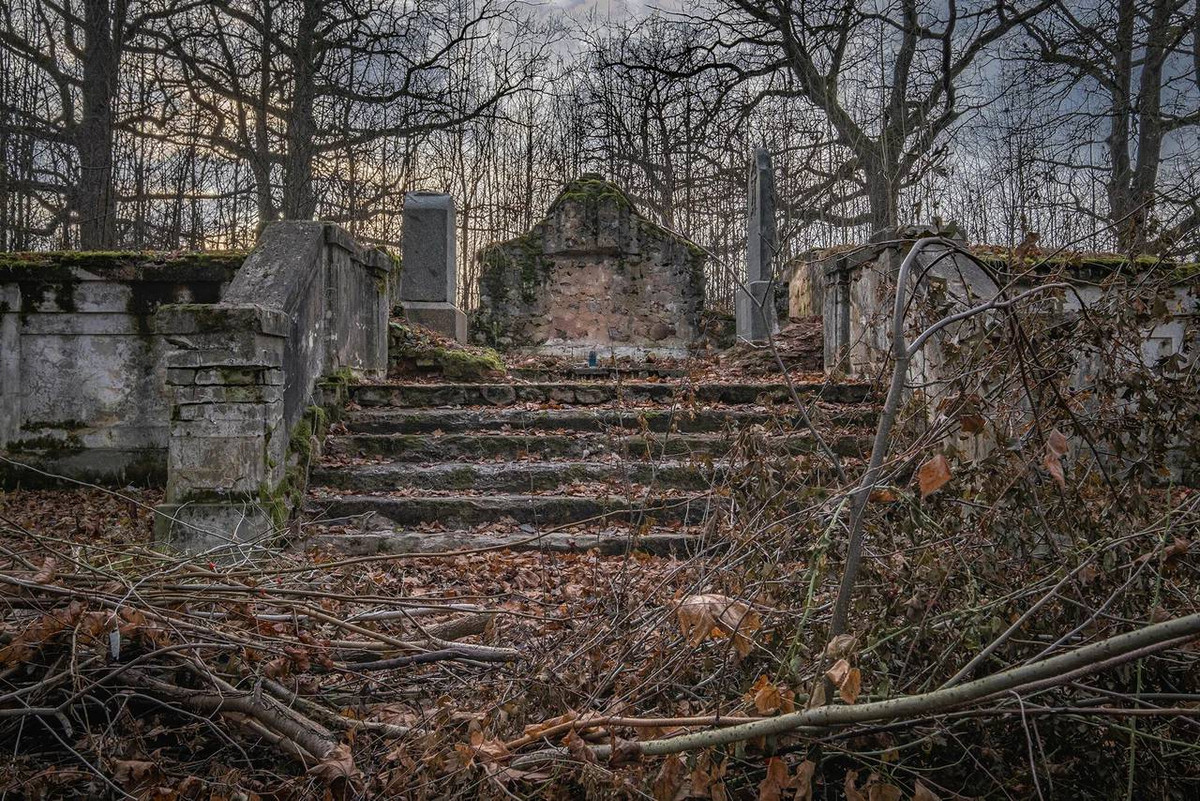
Just 15 kilometers from the famous Mir Castle, the ruins of Obrina Palace exist in their own layer of time — unmarked, largely forgotten, and hauntingly atmospheric. This was once a refined Neoclassical estate with an extraordinary architectural detail: pilasters capped with anthropomorphic figures — sculpted heads, torsos, and arms that appeared to support the cornice, an ornamental choice almost unheard of in Belarusian manor architecture. Today, the overgrown remains of the grain storage, stables, a stone tunnel beneath a chestnut allée, and the destroyed family chapel with intact tombstone plaques offer an experience of raw, unrestored history.
History
The estate gained prominence when Konstantin Dunin-Raetsky — a decorated Napoleonic officer who commanded the 18th Novogrudok Cavalry Regiment, held the Legion of Honor, and survived the catastrophic Berezina crossing in 1812 — acquired it in the early 19th century. His daughter Sophia married Yuzef Kashitscy, who led 400 men to capture Novogrudok during the 1830 uprising before being declared a state criminal and fleeing to Paris.
The Kashitscy family built the estate into a grand complex: a two-story Neoclassical palace with mansard roof, a flank building with Gothic pointed-arch windows, a four-story administrative tower with clock and bell, a dovecote with decorative balustrade, and a picturesque landscape park with lake, stream, and walking paths. The palace interior housed one of the region's most extensive porcelain collections, a painting gallery, Rococo-style wall sconces, and refined furniture.
The next generation's Konstantin Kashitscy joined the 1863 Kalinovsky uprising and faced sequestration of the family estates — he had to post a 9,000-ruble silver bond to regain management rights. Most of the art collections disappeared during the chaos of World War I.
On October 24, 1942, Soviet partisans from the "Komsomlets" detachment raided the estate, distributed the German-stored grain to local villages, and burned the palace. The last owner, Feliks Kashitscy, perished in the fire — accounts conflict on whether German forces killed him in reprisal or partisans left him in the burning building. After the war, Soviet authorities let villagers dismantle the remaining structures for building materials, erasing most traces of the estate.
The Kashitscy family built the estate into a grand complex: a two-story Neoclassical palace with mansard roof, a flank building with Gothic pointed-arch windows, a four-story administrative tower with clock and bell, a dovecote with decorative balustrade, and a picturesque landscape park with lake, stream, and walking paths. The palace interior housed one of the region's most extensive porcelain collections, a painting gallery, Rococo-style wall sconces, and refined furniture.
The next generation's Konstantin Kashitscy joined the 1863 Kalinovsky uprising and faced sequestration of the family estates — he had to post a 9,000-ruble silver bond to regain management rights. Most of the art collections disappeared during the chaos of World War I.
On October 24, 1942, Soviet partisans from the "Komsomlets" detachment raided the estate, distributed the German-stored grain to local villages, and burned the palace. The last owner, Feliks Kashitscy, perished in the fire — accounts conflict on whether German forces killed him in reprisal or partisans left him in the burning building. After the war, Soviet authorities let villagers dismantle the remaining structures for building materials, erasing most traces of the estate.
What to see
The atmospheric overgrown ruins: fragmentary grain storage walls, stable structure, and flank building foundations. The destroyed family burial chapel (1840s) with intact tombstone plaques still legible. The stone tunnel beneath the surviving chestnut tree allée — a 10-meter underground passage. Mysterious masonry features including an aqueduct-like structure and a buttressed wall emerging from the vegetation. The site is completely unmarked and unrestored — bring sturdy shoes and a sense of adventure.
Practical information
Location: village Pervomayski (renamed from Obrina in 1948), ~15 km from Mir Castle. No tourist infrastructure, no signs, no entrance fee. Can be combined with a visit to Mir Castle. GPS coordinates essential.
Share your photos or videos of this place
Sign in to upload photos and videos.
Adapted from: Onliner.by