
All attractions
Overview
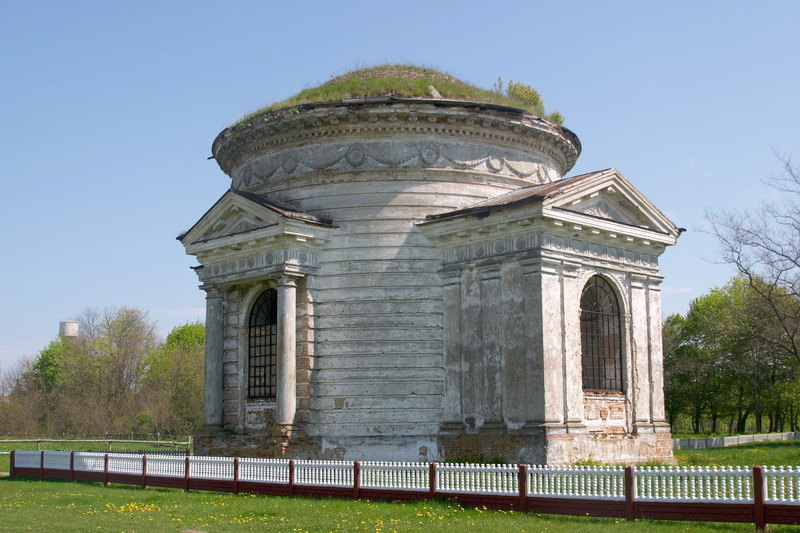
One of the most compelling noble estates in Belarusian Polesie, the Skirmunt estate in Molodovo tells the story of a remarkable dynasty that shaped the economic, cultural, and political life of the region across two centuries. The grand Neoclassical palace — with its eight Doric porticoes, white walls, and luxurious interiors filled with French furniture and paintings — was tragically destroyed during World War II, and its remains were dismantled by villagers rebuilding after the war. Today, only the elegant family chapel survives — a rotunda-style mausoleum built in 1905–1907, its dome restored but interior empty, standing as a silent witness to the grandeur that once was. Eight kilometers away in Porechye, the red-brick factory buildings and an overgrown 19th-century park with rare exotic trees survive as reminders of what was once called "Liverpool on the Yaselda River."
History
The Skirmunt family acquired the estates of Molodovo and Porechye from the Oginski family in the late 1700s. The first modest stone manor (1795) with 13 rooms was soon replaced by a grander Neoclassical palace — a single-story building on an elevated basement, adorned with eight Doric porticoes, white walls, and the family coat of arms on its pediments. Inside: 18th-century French furniture, paintings, an extensive library, and hunt-themed reception halls.
The family's most extraordinary chapter was written at Porechye, where Alexander Skirmunt established one of the region's first sugar refineries in 1830 and patented an innovative steam-powered evaporation apparatus — the first patent ever granted to a Belarusian inventor by the Russian Empire. His textile mill employed over 400 workers and earned the estate the nickname "Liverpool on the Yaselda River." Remarkably for the era, Skirmunt built worker housing, provided free meals, medical care, and education for workers' children.
Roman Skirmunt, the next generation, became a political visionary. As a deputy to the State Duma, he advocated for land reform and proposed "Kraevost" — a concept of regional identity unifying all peoples around shared territorial belonging rather than ethnic nationalism. In 1917 he led the Belarusian National Committee seeking autonomy. Local memory preserved him as the "good master" who provided grain during shortages, sold land to impoverished farmers at low prices, and spoke to people as equals in the local dialect.
In 1939, following the Soviet occupation, Roman Skirmunt was executed at age 71. According to local legend, he refused to turn his back before the firing squad, saying: "I have never turned my back on people."
The family's most extraordinary chapter was written at Porechye, where Alexander Skirmunt established one of the region's first sugar refineries in 1830 and patented an innovative steam-powered evaporation apparatus — the first patent ever granted to a Belarusian inventor by the Russian Empire. His textile mill employed over 400 workers and earned the estate the nickname "Liverpool on the Yaselda River." Remarkably for the era, Skirmunt built worker housing, provided free meals, medical care, and education for workers' children.
Roman Skirmunt, the next generation, became a political visionary. As a deputy to the State Duma, he advocated for land reform and proposed "Kraevost" — a concept of regional identity unifying all peoples around shared territorial belonging rather than ethnic nationalism. In 1917 he led the Belarusian National Committee seeking autonomy. Local memory preserved him as the "good master" who provided grain during shortages, sold land to impoverished farmers at low prices, and spoke to people as equals in the local dialect.
In 1939, following the Soviet occupation, Roman Skirmunt was executed at age 71. According to local legend, he refused to turn his back before the firing squad, saying: "I have never turned my back on people."
What to see
The surviving family chapel (rotunda mausoleum, 1905–1907) — the only architectural remnant of the estate, with its dome restored but the interior empty. In nearby Porechye (8 km): the red-brick factory building, now a potato starch plant, still standing from the Skirmunt industrial era. The overgrown 19th-century park featuring rare exotic species including swamp cypress and a tulip tree that blooms in yellow. The modest grave of Roman Skirmunt at the park's edge.
Share your photos or videos of this place
Sign in to upload photos and videos.
Adapted from: Onliner.by